
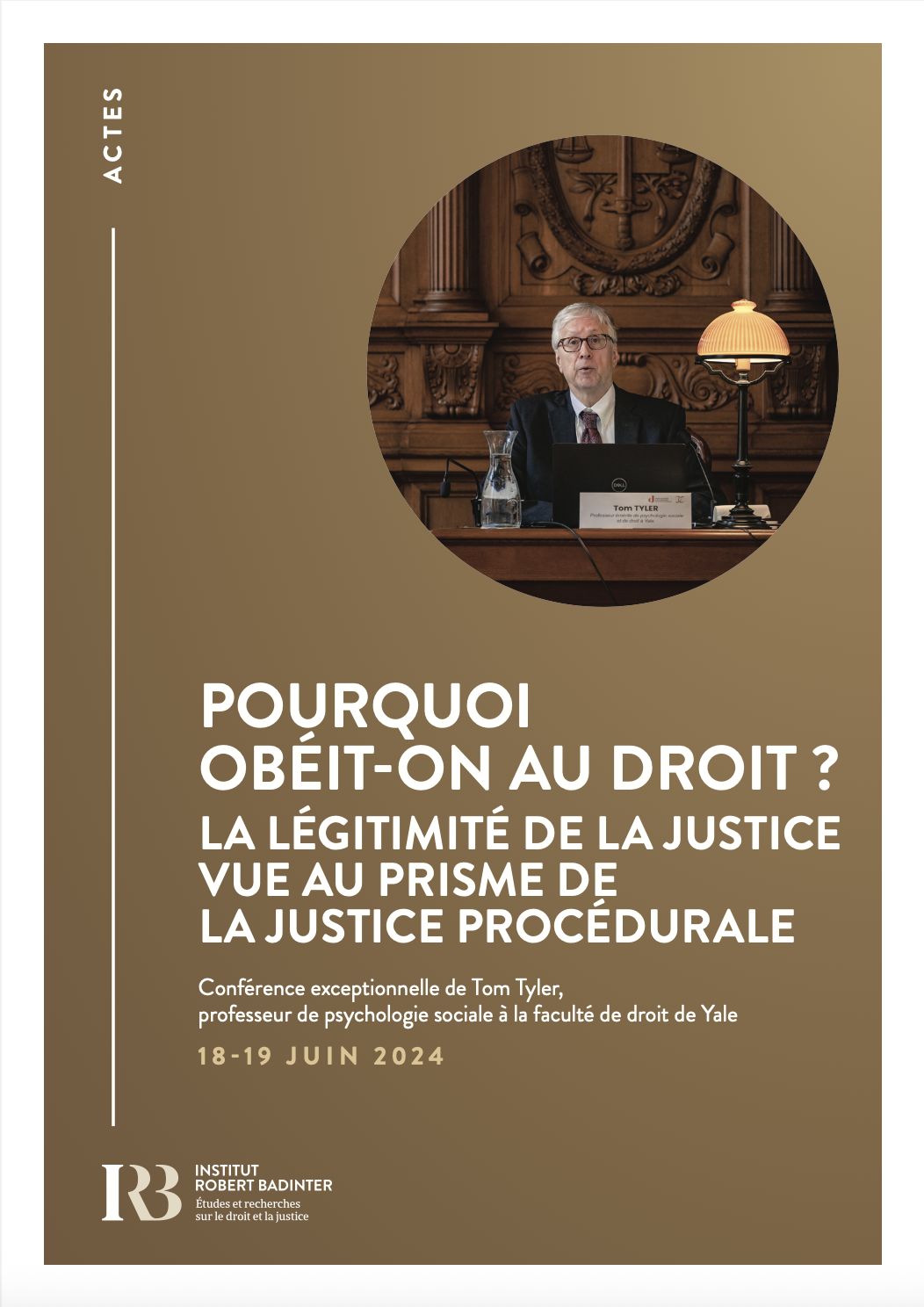
Pourquoi obéissons-nous à la loi ?
Qu’est-ce qui fonde la légitimité des institutions judiciaires ?
En juin 2024, le célèbre psychologue social américain Tom R. Tyler a honoré de sa présence l’Institut Robert Badinter (alors IERDJ) à l’occasion d’une conférence exceptionnelle à la chambre criminelle de la Cour de cassation, sur invitation de son Premier président, Monsieur Christophe Soulard.
Figure incontournable des sciences sociales appliquées au droit, Tom R. Tyler explore depuis des décennies les ressorts profonds de notre adhésion – ou non – à la justice et à ses représentants. Héritier intellectuel des pionniers de la justice procédurale, John Thibaut et Laurens Walker, il a su marier avec finesse psychologie sociale et recherche juridique pour éclairer les raisons du déclin du sentiment de légitimité des institutions judiciaires, notamment aux États-Unis.
À travers plus d’une quinzaine d’ouvrages, Tyler a ouvert la voie à une compréhension empirique du rapport que les citoyens entretiennent avec la justice et la police. Ce livre propose une introduction claire à sa pensée, encore largement méconnue en France, et donne à lire la retranscription fidèle de sa conférence parisienne.
Un regard essentiel pour repenser le lien entre justice et société.
Résumé en anglais / English version below
Why do we obey the law? What underpins the legitimacy of judicial institutions ? In June 2024, the renowned American social psychologist Tom R. Tyler honored the Robert Badinter Institute (then IERDJ) with his presence during an exceptional lecture held in the Criminal Chamber of the French Court of Cassation, at the invitation of its First President, Mr. Christophe Soulard. A key figure in the field of social sciences applied to law, Tom R. Tyler has spent decades exploring the deep-rooted reasons behind our adherence—or lack thereof—to justice and its institutions. An intellectual heir to the pioneers of procedural justice, John Thibaut and Laurens Walker, he has skillfully combined social psychology and legal research to shed light on the decline in public trust and the perceived legitimacy of judicial institutions, particularly in the United States. Through more than fifteen books, Tyler has paved the way for an empirical understanding of how citizens relate to justice and law enforcement. This book offers a clear introduction to his thought—still largely unknown in France—and includes a faithful transcript of his Paris lecture. An essential perspective for rethinking the relationship between justice and society.